Cybersecurity Awareness Month

Celebrate Cybersecurity Awareness month with Purdue!

Events

Events are for everyone, including students, faculty, and staff. All times are listed in ET. Learn more about BTAA Events

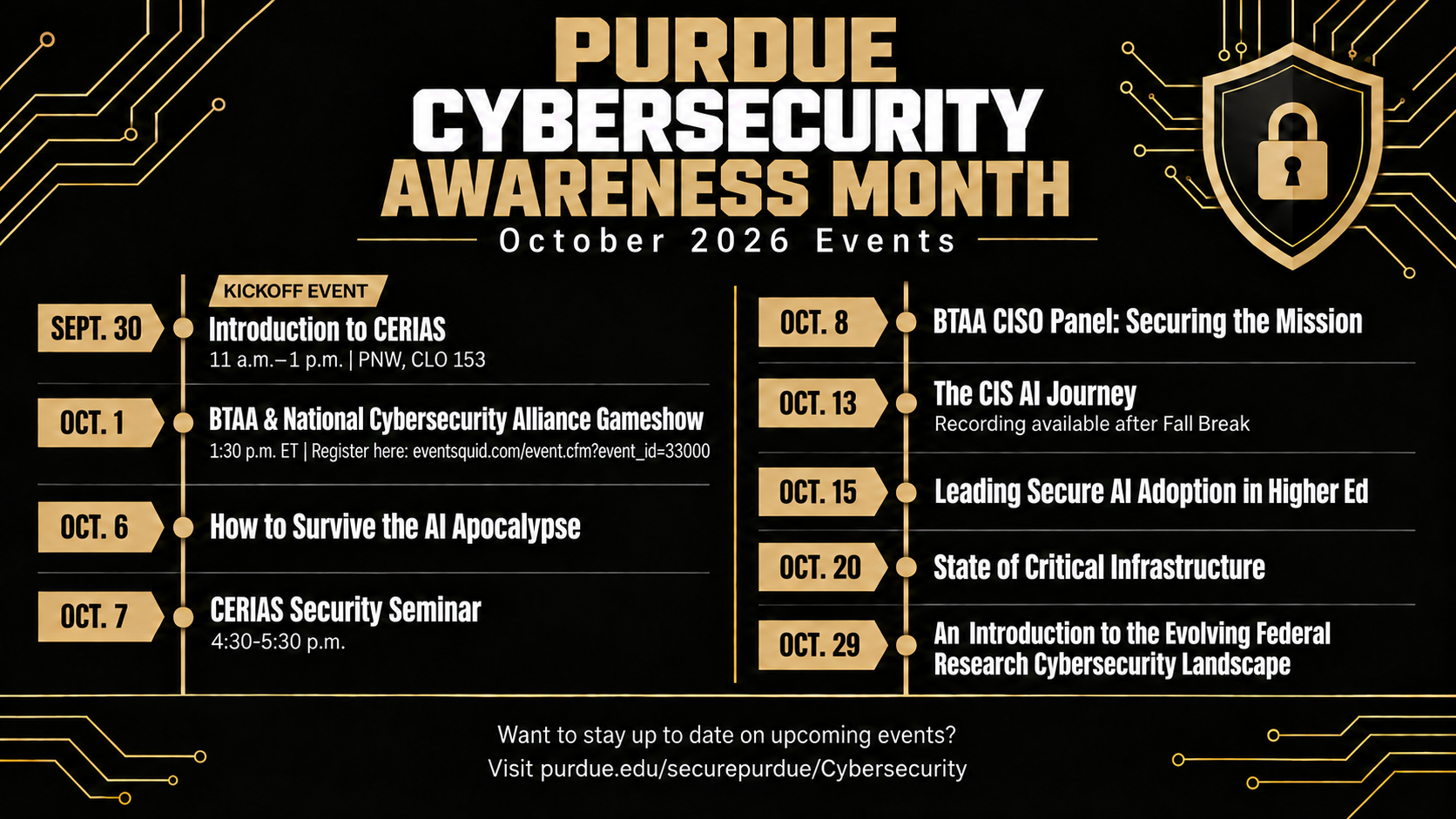
See overview of events:overview of events

CERIAS Security Seminar

Twenty years ago, the first post on the CERIAS blog took apart the rule that passwords must be changed every month. NIST retired the practice in 2017; some standards still require it. That is how a security myth works: a plausible claim, repeated in enough checklists, becomes infrastructure, and nobody audits infrastructure that seems to be working. The newest myth is that AI makes security professionals optional. This talk separates the three claims that marketing bundles together. AI tools do find flaws in shipped code, and the evidence from Google, DARPA, Mozilla, and Microsoft is real. Autonomous agents do add kinds of risk that no deployed security architecture was designed for. Neither fact implies that fewer people are needed. The vulnerability flood of 2026 is an audit of forty years of deferred engineering, not a crisis AI created, and the bottleneck has moved to the human capacity to verify, coordinate, and fix. The organizations that bet on replacement are already rehiring, often at a premium, the judgment they discarded. Open positions in the field number in the hundreds of thousands. For students, the message is direct: AI is not replacing you; it is generating your workload. The talk closes with what grows, what shrinks, and how to prepare. The capacities that make you a professional are the ones that do not become obsolete with the next model release. WHEN: October 7th, 4:30pm - 5:30pm. WHERE: Science Building (INLD), Room LD 002, Purdue Indianapolis & Virtual

The CIS AI Journey

Most organizations are being asked to adopt AI faster than they can answer basic questions about how to do it safely. At the Center for Internet Security, we chose to build our AI program governance first, before scaling use across the organization. This session walks through that journey candidly, including the questions we got right early, the ones we underestimated, and the places where our first plan needed real adjustment. Brian Calkin, CIS Chief Technology and Innovation Officer, will share how CIS stood up an AI governance board and a technical subcommittee, deployed enterprise AI tooling to staff, and worked through the security and data questions that surfaced along the way. What data can these tools touch? How do we vet vendors? Who reviews an agent before it acts on its own? How do we keep cost and sprawl under control? The talk focuses on what actually worked, what we changed, and what we are still figuring out. For higher education, the stakes are distinctive. Research, administrative, and IT environments each carry different data sensitivities and risk tolerances, and scaling AI across all three without a shared governance foundation invites trouble. Attendees will leave with a practical starting framework they can adapt, a set of questions worth answering before broad rollout, and a clear view of the tradeoffs from an organization living them now. WHEN: October 13th, 12:00 pm - 1:00 pm. WHERE: Virtual. NOTE: Recording will be available after fall break.

For any cybersecurity awareness related questions or training requests, please email  cyberaware@purdue.edu.

Purdue Global Purdue Fort Wayne Purdue Northwest Purdue West Lafayette